Waypoint-OPD gates distillation by early and late RL policy shifts
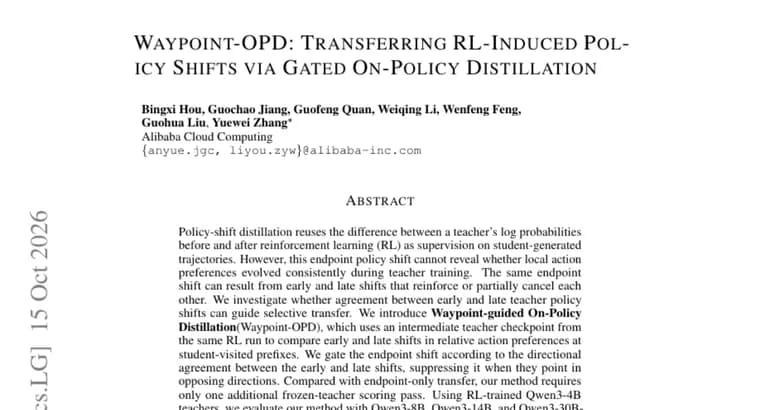
The paper starts from a technique called policy-shift distillation. A teacher model is trained with reinforcement learning (RL), and the difference between its log probabilities before and after RL is reused as supervision on trajectories generated by the student. The authors point to a weakness in this setup: the endpoint policy shift, the change from the start of RL to the end, cannot show whether the teacher's local action preferences changed consistently during training. The same endpoint shift can come from early and late shifts that reinforce each other, or from ones that partly cancel each other.
The authors ask whether agreement between early and late teacher policy shifts can guide selective transfer. Their answer is Waypoint-guided On-Policy Distillation (Waypoint-OPD). It takes an intermediate teacher checkpoint from the same RL run and uses it to compare early and late shifts in relative action preferences at prefixes the student actually visits. The endpoint shift is then gated by the directional agreement between the early and late shifts, and it is suppressed when they point in opposing directions. Compared with endpoint-only transfer, the method requires only one additional frozen-teacher scoring pass.
For evaluation, the authors use RL-trained Qwen3-4B teachers and three student models, Qwen3-8B, Qwen3-14B and Qwen3-30B-A3B, in mathematical and code reasoning. In all six domain-student settings, Waypoint-OPD achieves the highest domain-average score among the compared distillation methods. Ablations with the Qwen3-8B student show that removing or shuffling the gates reduces mathematical reasoning performance. The authors conclude that the results support using directional agreement between early and late teacher policy shifts to weight the endpoint shift during student training.
The abstract gives no numeric scores or margins over baselines, and it does not name the compared methods or the benchmarks.
Key facts
- Waypoint-OPD adds an intermediate checkpoint from the same RL run to compare early and late teacher policy shifts at student-visited prefixes.
- The endpoint shift is gated by directional agreement between the early and late shifts and suppressed when they point in opposing directions.
- Compared with endpoint-only transfer, the method needs only one additional frozen-teacher scoring pass.
- With RL-trained Qwen3-4B teachers and Qwen3-8B, Qwen3-14B and Qwen3-30B-A3B students, it has the highest domain-average score among compared distillation methods in all six domain-student settings.
- Ablations with the Qwen3-8B student show that removing or shuffling gates reduces mathematical reasoning performance.
Why it matters
Distilling what a teacher learned through RL, rather than just copying its outputs, is the idea behind policy-shift distillation. This paper argues that the usual endpoint signal hides how the teacher got there: identical endpoint shifts can be built from early and late shifts that agree or that partly cancel. Waypoint-OPD uses that observation to transfer the shift selectively instead of uniformly.
Who it affects
The work is aimed at researchers and engineers who distill RL-trained teachers into student models, particularly for mathematical and code reasoning. The evaluation covers Qwen3-8B, Qwen3-14B and Qwen3-30B-A3B students taught by Qwen3-4B teachers.
How to use it
The method needs an intermediate teacher checkpoint saved from the same RL run, since it compares early and late shifts. Beyond endpoint-only transfer, it costs one additional frozen-teacher scoring pass. No code or model release is mentioned.
How solid is it
This is a preprint abstract on Hugging Face Papers, and the claims are the authors' own. The headline result is that Waypoint-OPD has the highest domain-average score among the compared methods in all six domain-student settings. Ablations back up the gating, but they are stated for mathematical reasoning with the Qwen3-8B student only. No numeric scores or margins over baselines are given, and the compared distillation methods and benchmarks are not named.
Risks and caveats
Only Qwen3-4B teachers are used, and the source does not say whether other teacher sizes or model families were tested. Nothing is said about code reasoning in the ablations. No compute cost, wall-clock time or overhead figure is given beyond the one additional frozen-teacher scoring pass. No authors or institutions are named in the source.
“The same endpoint shift can result from early and late shifts that reinforce or partially cancel each other.”
— Paper abstract, Waypoint-OPD