WanPE turns rough prompts into cinematic scripts for Wan3.0 video generation
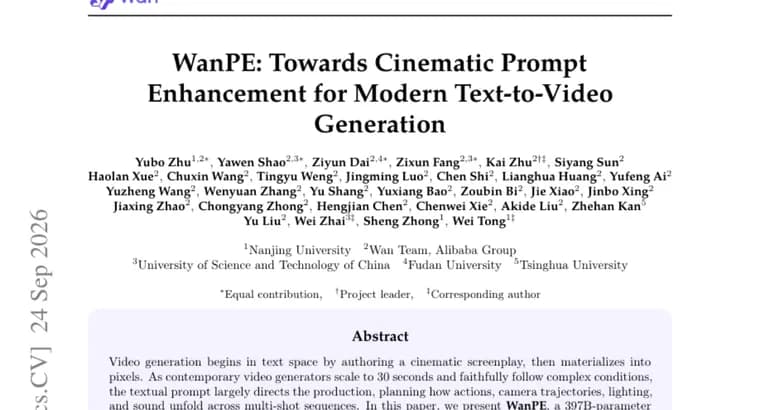
Researchers present WanPE, a 397-billion-parameter prompt enhancement model trained on 1.05 million real-world videos. Its job is not to generate video itself but to sit in front of a video generator and turn a raw, often terse user prompt into a director-level cinematic plan: a shot-by-shot script that spells out how actions, camera movement, lighting and sound should unfold across a multi-shot sequence. The idea is that as text-to-video systems now stretch to 30 seconds and follow increasingly complex instructions, the quality of the textual plan behind the scenes matters as much as the generator itself. WanPE builds these plans through what the authors call video-grounded reverse construction, and it is trained with a technique named Semantic-Consistency GRPO (SC-GRPO), meant to keep the plan faithful to what the user actually asked for across shots and over time. To measure whether this works, the team built WanPEval, a human-annotated testbed spanning video lengths from 5 to 30 seconds and different levels of prompt specificity, backed by roughly 11,000 blind pairwise human comparisons. When WanPE-397B is used to power Wan3.0's video generator, it boosts human preference over using the raw user prompt directly by 10.66 to 18.84 points for 5-15 second videos, and by a much larger 50.86 points for 30-second videos. Ablation studies in the paper show that the reverse-construction approach to building plans clearly outperforms simply rewriting prompts forward, and that SC-GRPO keeps the plan semantically faithful to the original request even as model scale changes. Comparing WanPE against other commercial systems, the authors report that it leads all evaluated commercial offerings on 5-15 second videos and stays competitive with Seedance 2.5 on 30-second videos.
Key facts
- WanPE is a 397B-parameter prompt enhancement model trained on 1.05M real-world videos to produce director-level cinematic plans from text prompts.
- It uses video-grounded reverse construction plus a training method called Semantic-Consistency GRPO (SC-GRPO) to keep plans faithful to the user's original request.
- A new human-annotated testbed, WanPEval, covers 5 to 30 second videos across about 11,000 blind pairwise assessments.
- Powering Wan3.0's video generator, WanPE-397B raises human preference by 10.66-18.84 points at 5-15 seconds and by 50.86 points at 30 seconds versus raw prompts.
- The authors say WanPE leads all evaluated commercial offerings at 5-15 seconds and remains competitive with Seedance 2.5 at 30 seconds.
Why it matters
As text-to-video generators stretch toward 30-second, multi-shot clips, the quality of the textual plan feeding the generator becomes a bottleneck of its own. WanPE targets that layer directly, treating prompt writing as a distinct, trainable skill rather than leaving it to the raw phrasing a user happens to type.
Who it affects
The work is aimed at text-to-video systems and the people building or using them, since WanPE is described as a component that plugs in front of a generator, in this case Wan3.0, to improve its output without changing the generator itself.
How to use it
The paper describes WanPE as a prompt enhancement model that sits ahead of a video generator, rewriting a user's prompt into a shot-level cinematic plan before generation happens; no pricing, licensing or public release details are given in the source text.
How solid is it
The claims come from the paper's own ablation studies and its WanPEval testbed, which is human-annotated and includes about 11,000 blind pairwise comparisons across 5 to 30 second videos, giving the headline numbers a concrete evaluation basis rather than an unmeasured claim.
Risks and caveats
The source text does not name the authors, their institutions, or a publication date, and it does not explain what GRPO stands for beyond the name Semantic-Consistency GRPO, nor how WanPEval's human annotators were selected or instructed, leaving some methodological details unverified.