WorldCast benchmark: GPT-Image-2.5 System scores 72.8, best open model 20.1
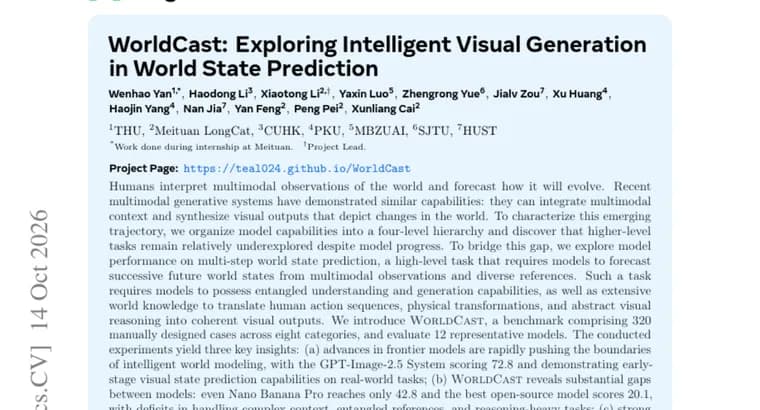
A new paper introduces WorldCast, a benchmark for multi-step world state prediction. The task asks a multimodal generative model to look at multimodal observations and diverse references, then forecast successive future world states as visual output. The authors describe it as a high-level task: the model has to turn human action sequences, physical transformations and abstract visual reasoning into coherent images, which takes entangled understanding and generation abilities plus extensive world knowledge.
The starting point is an observation about the field. The authors note that humans interpret multimodal observations and forecast how the world will evolve, and that recent multimodal generative systems show a similar ability: they can combine multimodal context and produce visual outputs that depict changes in the world. To map this trend, they organize model capabilities into a four-level hierarchy. Their finding is that higher-level tasks remain relatively underexplored despite model progress, and WorldCast is meant to fill that gap.
WorldCast comprises 320 manually designed cases across eight categories. The authors evaluate 12 representative models on it and report three key insights.
(a) Frontier models are rapidly pushing the boundaries of intelligent world modeling. The GPT-Image-2.5 System scores 72.8 and shows early-stage visual state prediction capabilities on real-world tasks.
(b) WorldCast reveals substantial gaps between models. Even Nano Banana Pro reaches only 42.8, and the best open-source model scores 20.1. The deficits show up in handling complex context, entangled references, and reasoning-heavy tasks.
(c) Strong generative models effectively draw on the capabilities of their underlying language models.
From this the authors conclude that the field needs multimodal generative models that can plan and reason dynamically while also being deeply unified, so that they can faithfully simulate real-world states.
Key facts
- WorldCast is a benchmark of 320 manually designed cases across eight categories, aimed at multi-step world state prediction from multimodal observations and references.
- The authors tested 12 representative models: the GPT-Image-2.5 System scored 72.8, Nano Banana Pro 42.8, and the best open-source model 20.1.
- The reported weak spots are complex context, entangled references and reasoning-heavy tasks.
- Strong generative models effectively draw on the capabilities of their underlying language models.
- The authors organize model capabilities into a four-level hierarchy and find that higher-level tasks remain relatively underexplored.
Why it matters
Image generators are increasingly asked to do more than draw a single picture: the paper frames the next step as depicting how the world changes over several steps. By the authors' account, tasks at the higher levels of their four-level capability hierarchy remain relatively underexplored, and WorldCast is their attempt to measure one of them. The headline spread is wide. The GPT-Image-2.5 System scores 72.8, Nano Banana Pro 42.8, and the best open-source model 20.1, so the benchmark separates models sharply.
Who it affects
Mainly researchers and builders of multimodal generative models, who get a test for forecasting successive world states rather than producing one image. The gap between the best open-source model (20.1) and the top proprietary systems is directly relevant to anyone choosing between open and closed image models for tasks that need reasoning over context. The authors' call for models that plan, reason and are deeply unified points at where they think development effort should go.
How to use it
The abstract describes the benchmark and its results, not a tool to run. What a reader can take from it is the task definition: give a model multimodal observations and diverse references, and ask it to produce the successive future states as visual output. The cases span human action sequences, physical transformations and abstract visual reasoning. For model builders, the stated deficits (complex context, entangled references, reasoning-heavy tasks) suggest where to probe a system first.
How solid is it
This is a paper abstract, so everything here is the authors' own account of their benchmark and findings. The cases were manually designed, 320 in total across eight categories, and 12 models were evaluated. The scores of 72.8, 42.8 and 20.1 are reported as given. The abstract names no authors or institutions. The scale, metric and scoring method behind 72.8, 42.8 and 20.1 are not given (not stated as percentages or out of 100). The best open-source model is not named. The abstract does not say how the cases were scored (human or automatic judges).
Risks and caveats
Read the numbers as relative, not absolute: the scale and metric are not given, so 72.8 should not be read as a percentage. The other models among the 12 are not listed, and beyond the three cited scores the abstract does not say which model ranks where. The eight categories and the four levels of the capability hierarchy are not described. No release date, code or dataset link, or license is given. The authors call the GPT-Image-2.5 result an early-stage capability, not a solved problem.
“strong generative models effectively draw on the capabilities of their underlying language models”
— WorldCast paper abstract