WorldReforge trains robot world models on 62k simulated failures
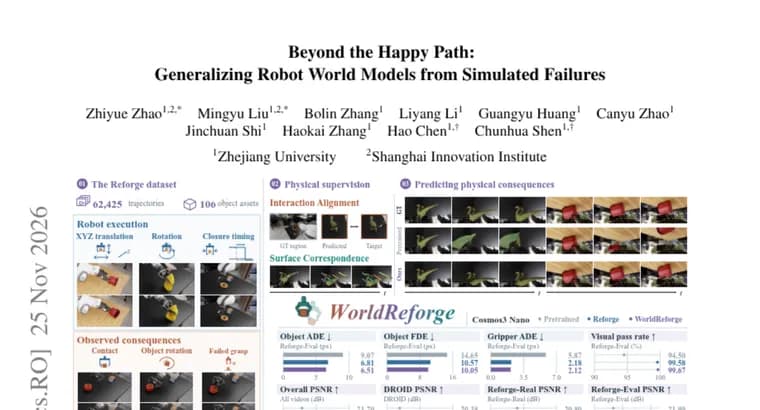
A paper titled "Beyond the Happy Path: Generalizing Robot World Models from Simulated Failures" presents WorldReforge, a method for teaching robot world models what happens when manipulation goes wrong. The authors say these models are increasingly used to evaluate and plan robot policies, yet robot training data are dominated by successful demonstrations. When a grasp is misaligned or mistimed and the object is pushed, tilted or slips, the models' predictions break down. To show the size of the problem, the authors compare five pretrained action-conditioned models with a static baseline that simply copies the first frame. The models' object-motion error is at most 10.4% lower than that baseline's, and two of the five do worse than it. The fix starts with data. The team built Reforge, a dataset of 62k simulated trajectories, by perturbing reference grasps in position, orientation and closure timing. Each resulting push, slip or failed pickup is recorded with ground-truth object pose, contact and surface points. WorldReforge turns that ground truth into two training signals without additional inference cost. Interaction Alignment focuses reconstruction on the small object and contact regions that a global loss underweights. Surface Correspondence trains the backbone's features to follow the same physical surface points across frames. On Cosmos3 Nano, the authors report that WorldReforge reduces object trajectory error by 28.2% overall and by 35.0% on unseen objects. It also lowers the error in predicting how the outcomes of two actions diverge by 43.3%. Although trained only in simulation, the method is reported to improve reconstruction on DROID and on real failure videos too. Controlled data studies, according to the authors, show that two kinds of experience teach complementary physics: failed contact teaches how objects respond, while successful holding teaches how a grasped state persists. The authors say code, data and models are available at aim-uofa.github.io/WorldReforge/.
Key facts
- Across five pretrained action-conditioned models, object-motion error is at most 10.4% lower than a copy-the-first-frame baseline, and two models are worse than it.
- The Reforge dataset holds 62k simulated trajectories made by perturbing grasp position, orientation and closure timing.
- Two training signals, Interaction Alignment and Surface Correspondence, use the simulator's ground truth without additional inference cost.
- On Cosmos3 Nano, object trajectory error falls 28.2% overall and 35.0% on unseen objects; error on how two actions' outcomes diverge falls 43.3%.
- Trained only in simulation, the method also improves reconstruction on DROID and real failure videos, the authors report.
Why it matters
World models are increasingly used to evaluate and plan robot policies, according to the authors. A model that mostly learns from successful demonstrations can break down at the moment a grasp fails. The baseline comparison makes the point sharply: none of the five pretrained models beats a frozen first frame by more than 10.4% on object-motion error, and two lose to it. WorldReforge's answer is to supply the missing failures from simulation and to train on what the simulator knows about objects, contact and surfaces.
Who it affects
The work is most relevant to researchers and engineers who build robot world models or rely on them to evaluate and plan manipulation policies. It also speaks to people assembling robot training data. The authors' data studies suggest that failed contact and successful holding each teach something the other does not, so both have a place in a training set.
How to use it
The authors say their code, data and models are available at aim-uofa.github.io/WorldReforge/. The recipe has two parts. First, perturb reference grasps in simulation and record the resulting pushes, slips and failed pickups with ground-truth object pose, contact and surface points. Second, train with Interaction Alignment, which weights reconstruction toward object and contact regions, and Surface Correspondence, which makes features track physical surface points across frames. The abstract states no license or training cost.
How solid is it
These are the authors' own results, from a research paper. The headline gains of 28.2%, 35.0% and 43.3% are reported for Cosmos3 Nano only, as relative reductions, and the abstract does not explicitly name the comparison baseline or give absolute error values. The improvement on DROID and real failure videos is described as better reconstruction, with no figures attached. The five pretrained models in the opening comparison are not named.
Risks and caveats
The method is trained only in simulation. Its reported real-data benefit concerns reconstruction on DROID and real failure videos, which is a different measure from the object trajectory error cited for Cosmos3 Nano. The abstract reports no real-robot policy success rates and no results from downstream policy evaluation or planning, so readers should not assume the lower prediction error translates into better robot behaviour. The claim of no added cost refers to inference.
“failed contact teaches how objects respond, and holding teaches how a grasped state persists.”
— The WorldReforge paper's abstract