HALO data collection system speeds robot demos up to 2.9x over Mobile ALOHA
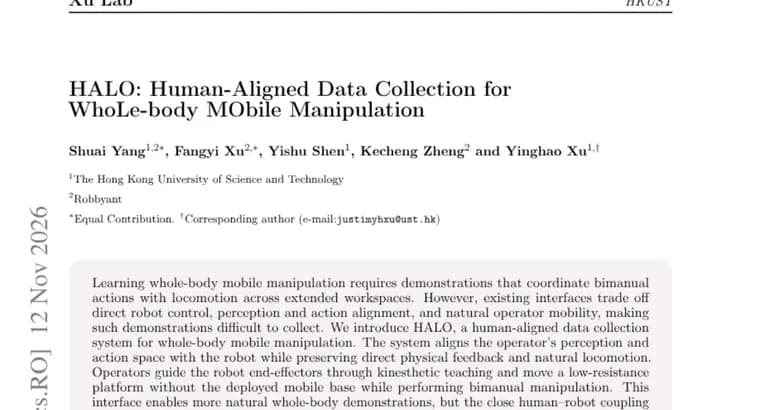
A paper on Hugging Face introduces HALO, a human-aligned data collection system for whole-body mobile manipulation. The problem it targets: learning this kind of manipulation needs demonstrations that coordinate two-handed actions with locomotion across large workspaces. The authors say existing interfaces trade off three things: direct robot control, alignment between what the operator perceives and does and what the robot does, and the operator's natural mobility. That trade-off makes such demonstrations difficult to collect.
HALO is built to align the operator's perception and action space with the robot while keeping direct physical feedback and natural locomotion. Operators guide the robot's end-effectors through kinesthetic teaching, meaning they move the robot's hands by hand. While doing bimanual manipulation, they also move a low-resistance platform that stands in for the deployed mobile base. The authors say this allows more natural whole-body demonstrations.
The close coupling between human and robot has a cost: the demonstration setting differs from the deployment setting. To handle this, the authors add what they call deployment-aligned demonstration processing. It calibrates and temporally aligns the platform's motion with the response of the deployed base. It also masks and inpaints the demonstrator's hands in the recorded observations.
On results, the authors report that compared with Mobile ALOHA and VR teleoperation, HALO enables up to 2.9x faster demonstration collection while maintaining comparable or higher success rates. Policies trained with HALO perform precise manipulation tasks, including zip-tie fastening. They also reach a 73.3% success rate on a six-stage long-horizon mobile manipulation task that involves repeated coordinated base and arm motion. A project page is linked from the abstract at robbyant-research.github.io/Lingbot-ALOHA.
Key facts
- HALO is a data collection system for whole-body mobile manipulation: operators guide the robot's end-effectors by kinesthetic teaching and move a low-resistance platform in place of the deployed mobile base.
- The authors report up to 2.9x faster demonstration collection than Mobile ALOHA and VR teleoperation, with comparable or higher success rates.
- Deployment-aligned processing calibrates and temporally aligns platform motion with the deployed base response, and masks and inpaints the demonstrator's hands in recorded observations.
- Policies trained with HALO handle precise tasks such as zip-tie fastening and reach 73.3% success on a six-stage long-horizon task.
Why it matters
Whole-body mobile manipulation needs demonstrations that combine bimanual actions with movement through large spaces. The authors argue that current interfaces force a trade-off between direct robot control, perception and action alignment, and natural operator mobility. HALO tries to keep all three, and the reported gain is faster collection, up to 2.9x against Mobile ALOHA and VR teleoperation.
Who it affects
Robotics researchers and teams who collect demonstrations to train mobile manipulation policies are the direct audience. The abstract frames the work around the data collection step, not around a finished robot product.
How to use it
The abstract describes the workflow: an operator guides the robot's end-effectors by kinesthetic teaching and moves a low-resistance platform without the deployed mobile base, then the recordings go through deployment-aligned processing. A project page is linked at https://robbyant-research.github.io/Lingbot-ALOHA/.
How solid is it
These are the authors' own reported results, taken from the paper's abstract. The 2.9x figure is stated as 'up to', so it is a maximum, not a typical speedup. The 73.3% success rate on the six-stage task is given without baseline success rates, so it cannot be compared with Mobile ALOHA or VR teleoperation from this text. The abstract gives no absolute collection times, numbers of demonstrations, trials or operators.
Risks and caveats
The authors acknowledge that close human-robot coupling introduces discrepancies between the demonstration and deployment settings, which is why the extra processing step is needed. The abstract does not say which task the 2.9x speedup was measured on, and it describes no limitations or failure cases.