James Webb telescope finds water and CO2 ice around Beta Pictoris
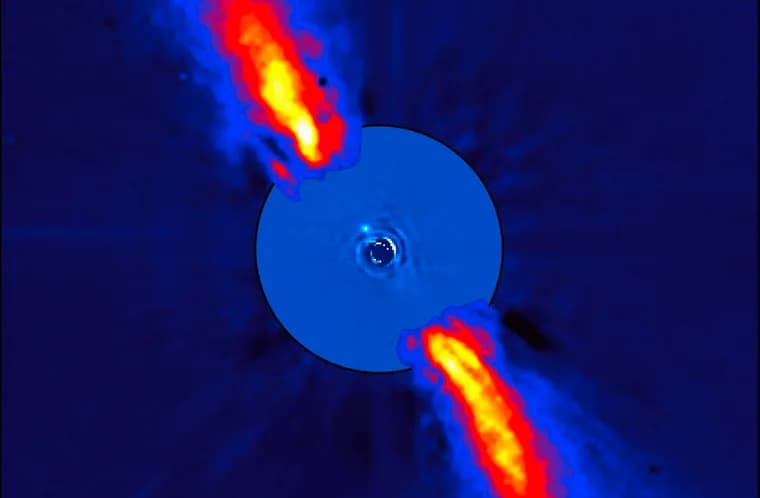
Beta Pictoris is a young star, roughly 20 million years old and about 64 light-years from Earth. It is surrounded by a vast disk of dust and rubble in which planets are still forming; astronomers have already found three. In a new Science study, a team led by Sarah Betti, an astronomer at the Space Telescope Science Institute in Baltimore, used the James Webb Space Telescope to look for ice in that disk. The researchers found both water ice and carbon dioxide ice.
The water ice is glassy rather than crystalline, and it is mixed with carbon dioxide in roughly the same proportions seen in comets of our own Solar System. The article says this suggests the ingredients needed to form water-rich worlds might be common around young stars.
The star is one of the best studied in the sky. Its disk was among the first ever imaged, back in 1984, and it is seen almost exactly edge-on, which makes it a natural laboratory for studying how planetary systems grow. It is a debris disk: the dust is constantly replenished by collisions among comets and planetesimals, the small bodies that are the building blocks of planets.
There were good reasons to expect ice. The outer parts of the disk are far enough from the star that water and other volatile molecules should freeze into solid ice. The disk also holds a large reservoir of carbon monoxide gas, which the star's ultraviolet light should destroy within 50 to 300 years. For the gas to still be there, something must keep replenishing it, and the most likely source is release from ice when volatile-rich comets collide. The properties of the planet Beta Pictoris b also suggest it formed from ice-rich material.
Yet earlier searches had come up empty. Attempts to detect water vapor found nothing, and a search for the telltale dip that water ice leaves in starlight at a wavelength of 3 micrometers also failed. The new Webb result is the first detection of ice in this disk described in the article.
Key facts
- A team led by Sarah Betti of the Space Telescope Science Institute in Baltimore used the James Webb Space Telescope to find both water ice and carbon dioxide ice in the debris disk of Beta Pictoris, in a new Science study.
- The water ice is glassy rather than crystalline, and it is mixed with carbon dioxide in roughly the same proportions seen in Solar System comets.
- Beta Pictoris is roughly 20 million years old and about 64 light-years away; astronomers have already found three planets in its disk.
- Earlier searches had failed: attempts to detect water vapor found nothing, and a search for water ice's 3 micrometer dip in starlight also failed.
- The article says the result suggests ingredients needed to form water-rich worlds might be common around young stars.
Why it matters
Theory predicted ice here. The outer disk is cold enough for water and other volatiles to freeze, and the large reservoir of carbon monoxide gas needs a source, most likely ice released when volatile-rich comets collide. Yet earlier searches, for water vapor and for the 3 micrometer dip of water ice, found nothing. Webb's detection fills that gap in one of the best studied stars in the sky. The match between the ice mix and the proportions seen in Solar System comets is what leads the article to suggest that the ingredients for water-rich worlds might be common around young stars.
Who it affects
Mainly astronomers who study how planetary systems form, and those who use Beta Pictoris, whose disk is seen almost exactly edge-on, as a natural laboratory for it. The article also notes that the properties of the planet Beta Pictoris b already suggest it formed from ice-rich material, but it draws no link from the new result to how the star's planets are interpreted.
How to use it
This is a scientific result, not a product or tool. It is published in Science, and the article gives no instrument settings, data release or software. Readers who want the detection details should go to the paper itself.
How solid is it
The result comes from a peer-reviewed Science study led by Sarah Betti, an astronomer at the Space Telescope Science Institute in Baltimore. The article reports the detection of water and carbon dioxide ice, the glassy form of the water ice and the comet-like mix as findings of the study. The broader conclusion about water-rich worlds is hedged in the source itself: it says the result suggests the ingredients might be common.
Risks and caveats
The step from this one disk to young stars in general is an inference, and the source words it with "suggests" and "might". The article does not say that water-rich worlds exist or are forming around Beta Pictoris. No amounts or masses of ice are given, and neither is the exact water-to-carbon-dioxide ratio. No age of the ice is given either, so the claim in the original headline that the ice is older than the star is not something the text itself supports.
“Researchers found both water and carbon dioxide ice.”
— Ars Technica