JustRUA harness lifts GPT-6 Astra robot agents from 29.7 to 50.3 on RoboDojo
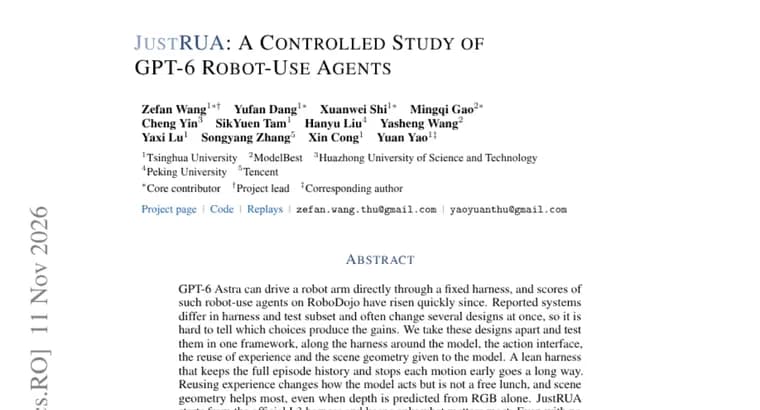
The paper starts from a premise: GPT-6 Astra can drive a robot arm directly through a fixed harness, and scores of such robot-use agents on the RoboDojo simulation benchmark have risen quickly since. The authors point out a problem with the reported results. Systems differ in harness and in the test subset they use, and they often change several designs at once, so it is hard to tell which choices actually produce the gains.
To separate them, the authors take these designs apart and test them in one framework. They vary four dimensions: the harness around the model, the action interface, the reuse of experience, and the scene geometry given to the model.
Three findings come out of that. First, a lean harness that keeps the full episode history and stops each motion early goes a long way. Second, reusing experience changes how the model acts, but it is not a free lunch. Third, scene geometry helps most, even when depth is predicted from RGB alone.
The authors then build JustRUA, a simple harness that starts from the official L3 harness and keeps only what matters most. It uses no learned policy, no self-improvement loop and no task-specific tuning. Even so, it raises the score on the RoboDojo simulation benchmark substantially, from 29.7 to 50.3.
Key facts
- JustRUA is a simple harness for GPT-6 Astra robot-use agents; it starts from the official L3 harness and keeps only what matters most.
- It raises the RoboDojo simulation benchmark score from 29.7 to 50.3 with no learned policy, self-improvement loop or task-specific tuning.
- The authors test four design dimensions in one framework: the harness, the action interface, experience reuse and the scene geometry given to the model.
- A lean harness that keeps the full episode history and stops each motion early goes a long way; reusing experience is not a free lunch.
- Scene geometry helps most, even when depth is predicted from RGB alone.
Why it matters
Robot-use agent scores on RoboDojo have climbed quickly since GPT-6 Astra became able to drive a robot arm, but the authors say the reported systems differ in harness and test subset and change several things at once. That makes it hard to know what actually drives progress. A controlled comparison in one framework is aimed at exactly that gap, and the result is that a lean design with simple ingredients carries much of the gain.
Who it affects
Teams building robot-use agents on top of GPT-6 Astra and groups that report results on RoboDojo. The findings bear on how they design the harness around the model, the action interface, experience reuse and the scene information they feed in.
How to use it
The paper's practical advice is to start from the official L3 harness and keep only what matters most. In its tests that means keeping the full episode history, stopping each motion early, and giving the model scene geometry, which helped most even when depth was predicted from RGB alone. The authors treat experience reuse with caution. No code or model release is mentioned.
How solid is it
This is a preprint listed on Hugging Face Papers. The headline result is a single pair of numbers on a simulation benchmark, 29.7 to 50.3. The unit or scale of the score is not stated, e.g. whether it is a success rate in percent. It is also not stated whether 29.7 is the score of the unmodified official L3 harness or of some other baseline. No per-component breakdown of how much each design choice contributes is given.
Risks and caveats
No real-robot results are mentioned; the reported score is on a simulation benchmark. No details of the depth-prediction method, the action interface or the experience-reuse mechanism are given. The conclusions are the authors' own reading of their experiments, so treat the 50.3 figure as a claim to be reproduced rather than a settled benchmark standing.
“A lean harness that keeps the full episode history and stops each motion early goes a long way.”
— JustRUA paper, Hugging Face Papers