Survey asks why self-improvement methods for multimodal agents transfer unevenly across four scenarios
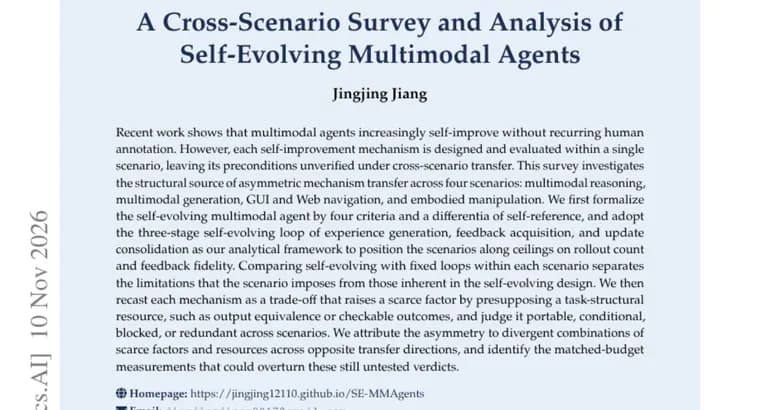
The survey starts from a trend: recent work shows that multimodal agents increasingly self-improve without recurring human annotation. The catch, the authors say, is that each self-improvement mechanism is designed and evaluated within a single scenario. Whether it still works when moved to another scenario has gone unverified.
The survey investigates the structural source of this asymmetric transfer across four scenarios: multimodal reasoning, multimodal generation, GUI and Web navigation, and embodied manipulation.
The method has several steps. First, the authors formalize the self-evolving multimodal agent by four criteria and a differentia of self-reference. Second, they adopt a three-stage self-evolving loop as the analytical framework: experience generation, feedback acquisition, and update consolidation. With that loop they position the scenarios along ceilings on rollout count and feedback fidelity. Third, they compare self-evolving loops with fixed loops within each scenario. That comparison separates the limitations the scenario imposes from those inherent in the self-evolving design.
Next, each mechanism is recast as a trade-off. It raises a scarce factor by presupposing a task-structural resource, such as output equivalence or checkable outcomes. The authors then judge each mechanism portable, conditional, blocked, or redundant across scenarios.
Their explanation for the asymmetry is that scarce factors and resources combine differently across opposite transfer directions. Finally, they identify the matched-budget measurements that could overturn these verdicts, which the abstract itself calls still untested.
Key facts
- The survey compares four scenarios: multimodal reasoning, multimodal generation, GUI and Web navigation, and embodied manipulation.
- Its analytical framework is a three-stage self-evolving loop of experience generation, feedback acquisition, and update consolidation, used to position scenarios along ceilings on rollout count and feedback fidelity.
- Each mechanism is recast as a trade-off that presupposes a task-structural resource (examples given: output equivalence, checkable outcomes) and is judged portable, conditional, blocked, or redundant.
- The authors attribute asymmetric transfer to divergent combinations of scarce factors and resources across opposite transfer directions.
- The verdicts are described as still untested, and the authors identify matched-budget measurements that could overturn them.
Why it matters
Self-improvement without recurring human annotation is, per the abstract, a growing pattern in multimodal agents. The survey points out a gap: each mechanism is built and tested in one scenario, so nobody knows whether its preconditions hold elsewhere. The paper tries to explain, in structural terms, why a method that works in one setting may not carry over to another, and why transfer can differ by direction.
Who it affects
Researchers building self-improving multimodal agents in any of the four scenarios: multimodal reasoning, multimodal generation, GUI and Web navigation, and embodied manipulation. The framing is most relevant to anyone considering moving a self-improvement mechanism from one of these settings to another.
How to use it
The abstract offers a way of thinking rather than a tool. Break a self-evolving agent into experience generation, feedback acquisition, and update consolidation. Check how many rollouts and how faithful a feedback signal the scenario allows. Compare against a fixed loop in the same scenario to see whether a limit comes from the scenario or from the self-evolving design. Then ask which task-structural resource a mechanism presupposes, such as output equivalence or checkable outcomes, and whether the target scenario provides it.
How solid is it
The only material available is the survey's abstract. The authors themselves call their portable, conditional, blocked, or redundant verdicts still untested. No quantitative results, benchmarks, or measured transfer numbers are reported. The abstract does not say which specific mechanisms fall into which category. This is a conceptual analysis whose proposed matched-budget measurements are yet to be run.
Risks and caveats
Treat the classifications as hypotheses. The authors say matched-budget measurements could overturn them. The abstract names no specific agents, models, or systems, so it gives no way to check the claims against particular work. The four scenarios are the scope of the analysis, and nothing in the abstract extends the conclusions beyond them.
“We attribute the asymmetry to divergent combinations of scarce factors and resources across opposite transfer directions”
— Survey abstract, Hugging Face papers listing 2611.14256