Neuro-VL, trained on nearly one million neuroimaging studies, beats frontier models, authors say
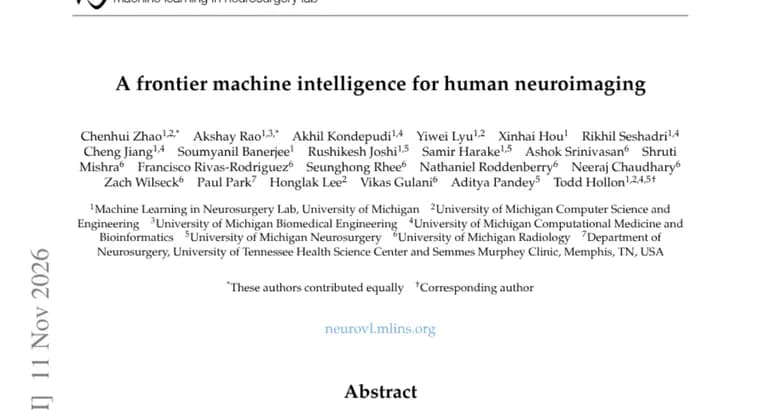
A new paper introduces Neuro-VL, a vision-language model for neuroimaging. It was trained on nearly one million neuroimaging studies from routine clinical care. The authors say it can interpret complete imaging examinations and hold natural language conversations about their findings.
The paper starts from a gap it sees in current systems. Medical imaging is essential for diagnosing disease, guiding treatment and monitoring patients over time. But the authors write that existing medical models often address restricted tasks, while general-purpose proprietary models lack access to the private clinical imaging needed to reach medical expertise. Building models that can interpret complex examinations and explain their findings in the context of clinical decisions, they say, remains a major challenge.
The headline claim concerns performance. According to the authors, across internal and international datasets Neuro-VL outperformed frontier general-purpose and specialized medical models. The tasks named are diagnosing, localizing and describing abnormalities, and generating comprehensive radiology reports.
Two further abilities are reported. The model compared serial examinations to assess disease progression. And the authors say it more reliably resisted misleading clinical assumptions than leading frontier models from OpenAI and Google.
The authors conclude that the results extend health system learning beyond individual predictions to interactive image interpretation and longitudinal disease monitoring. They say the work shows how the collective clinical experience of health systems can be used to develop medical AI with specialized expertise and broad clinical capabilities.
The text available is the paper's abstract. It gives no scores or effect sizes, so "outperformed" comes without numbers.
Key facts
- Neuro-VL is a vision-language model trained on nearly one million neuroimaging studies from routine clinical care.
- The authors say it interprets complete imaging examinations and converses in natural language about the findings.
- Across internal and international datasets, it reportedly outperformed frontier general-purpose and specialized medical models at diagnosing, localizing and describing abnormalities and at generating radiology reports.
- It also compared serial examinations to assess disease progression, and the authors say it resisted misleading clinical assumptions more reliably than leading frontier models from OpenAI and Google.
- No benchmark scores, accuracy figures or effect sizes are given; 'outperformed' is stated without numbers.
Why it matters
The paper targets two weaknesses the authors name: existing medical models often handle only restricted tasks, and general-purpose proprietary models lack access to private clinical imaging. Neuro-VL is presented as a model built from routine clinical data that covers whole examinations, conversation, reporting and tracking change over time. The authors frame it as a step from individual predictions toward interactive image interpretation and longitudinal disease monitoring.
Who it affects
The subject is neuroimaging, so the people closest to it are clinicians who read and report such studies, and the health systems whose routine clinical care produced the training data. Medical AI developers are the other audience, since the authors argue that the collective clinical experience of health systems can be used to build specialized models. No clinical deployment is mentioned.
How to use it
Nothing in the abstract describes a way to use the model. There is no information on model size, architecture, or whether the model or data is publicly released. No clinical deployment, regulatory approval, or prospective clinical trial is mentioned. For now it is a research result to read, not a tool to adopt.
How solid is it
The claims are the authors' own, drawn from the paper's abstract. The comparison is said to span internal and international datasets, but those datasets are not identified, and no countries or hospitals are named. The specific OpenAI and Google models are not named, and the baselines for diagnosis and reporting are not named either. No benchmark scores, accuracy figures or effect sizes are given. No authors or institutions are named in the abstract.
Risks and caveats
Without numbers, the size of the advantage cannot be judged. No comparison against human radiologists is mentioned. The claim about resisting misleading clinical assumptions is made against leading frontier models from OpenAI and Google, but the abstract does not say which models. No clinical deployment, regulatory approval, or prospective clinical trial is mentioned, so the results should be read as reported research findings.
“They demonstrate how the collective clinical experience of health systems can be used to develop medical AI with specialized expertise and broad clinical capabilities.”
— Abstract of the Neuro-VL paper