New benchmark shows moving traffic can hijack drone video stabilization
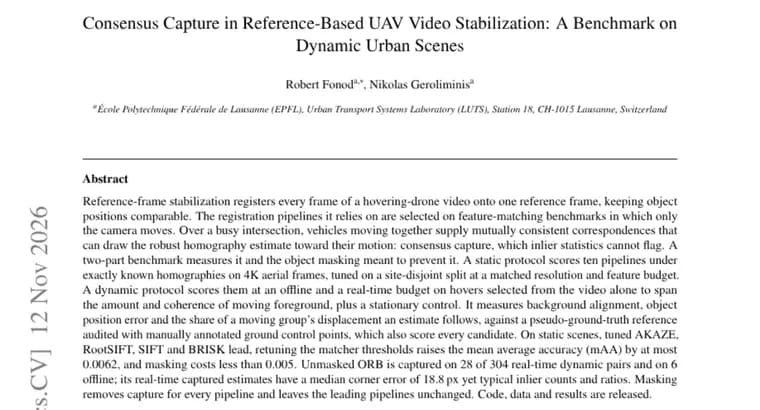
Reference-frame stabilization registers every frame of a hovering-drone video onto one reference frame, so that object positions stay comparable from frame to frame. The registration pipelines it relies on, the paper says, are chosen on feature-matching benchmarks in which only the camera moves. Real footage is messier. Over a busy intersection, vehicles moving together supply mutually consistent correspondences that can draw the robust homography estimate toward their motion. The paper calls this consensus capture, and notes that inlier statistics cannot flag it.
To measure the problem, the paper presents a two-part benchmark that scores both consensus capture and the object masking meant to prevent it. The static protocol scores ten pipelines on 4K aerial frames under exactly known homographies, tuned on a site-disjoint split at a matched resolution and feature budget. The dynamic protocol scores the pipelines at an offline budget and a real-time budget. It uses hovers selected from the video alone, chosen to span the amount and coherence of moving foreground, plus a stationary control. It measures background alignment, object position error and the share of a moving group's displacement that an estimate follows. Scoring is against a pseudo-ground-truth reference, audited with manually annotated ground control points, which also score every candidate.
On static scenes, tuned AKAZE, RootSIFT, SIFT and BRISK lead. Retuning the matcher thresholds raises mean average accuracy (mAA) by at most 0.0062, and masking costs less than 0.005. On dynamic scenes, unmasked ORB is captured on 28 of 304 real-time dynamic pairs and on 6 offline pairs. Its captured real-time estimates have a median corner error of 18.8 px, yet they show typical inlier counts and ratios, so the usual quality signals would not reveal the failure. Masking removes capture for every pipeline and leaves the leading pipelines unchanged. Code, data and results are released.
Key facts
- Consensus capture: vehicles moving together over a busy intersection give mutually consistent correspondences that can pull the robust homography estimate toward their motion, and inlier statistics cannot flag it.
- The static protocol scores ten pipelines on 4K aerial frames with exactly known homographies; tuned AKAZE, RootSIFT, SIFT and BRISK lead, and masking costs less than 0.005.
- Unmasked ORB is captured on 28 of 304 real-time dynamic pairs and on 6 offline pairs, with a median corner error of 18.8 px on its captured real-time estimates.
- Captured ORB estimates still show typical inlier counts and ratios, so those statistics do not reveal the failure.
- Masking removes capture for every pipeline and leaves the leading pipelines unchanged; code, data and results are released.
Why it matters
Pipelines for stabilizing hovering-drone video are picked on benchmarks where only the camera moves, which is not what a drone sees over a busy intersection. This paper gives that gap a name, consensus capture, and a way to measure it. The finding that matters most is that a failing estimate can look healthy: captured ORB estimates had a median corner error of 18.8 px while their inlier counts and ratios stayed typical.
Who it affects
People who stabilize footage from hovering drones onto a single reference frame and then compare object positions across time, especially over scenes with moving traffic. It also concerns anyone choosing a feature-matching pipeline for that job from camera-only benchmark results.
How to use it
The paper releases code, data and results, so the benchmark can be used to test a registration pipeline against moving foreground before trusting it. The practical reading of the numbers: on static scenes masking costs less than 0.005, and on dynamic scenes it removed capture for every pipeline without changing which pipelines lead. Retuning matcher thresholds gave at most 0.0062 mAA on static scenes.
How solid is it
The numbers come from the paper's own benchmark. The static protocol uses exactly known homographies, which is a firm reference. The dynamic protocol uses a pseudo-ground-truth reference, audited with manually annotated ground control points that also score every candidate. Hovers were selected from the video alone to span the amount and coherence of moving foreground, and a stationary control is included. The account here rests on the paper's abstract.
Risks and caveats
The source gives capture rates and corner errors only for unmasked ORB, not for other pipelines. The denominator for the 6 offline captures is not stated. The masking method is not described, so how moving objects are masked cannot be judged. No static-scene mAA values are given for the leading pipelines, only the bounds on the retuning gain and masking cost. The source does not say how many sites were filmed or where beyond a busy intersection and 4K aerial frames.
“Masking removes capture for every pipeline and leaves the leading pipelines unchanged.”
— Paper abstract, Hugging Face papers listing