A preliminary experiment kept the tasks the same and changed only what Claude Code was told about its code's use. It took more turns, kernel runs got slower, and the effect on quality was less clear. →
From January 2027, Gmail will stop users sending from addresses Google does not host, including own-domain addresses forwarded by Cloudflare Email Routing. A guide on emailfa.st sets out four ways to keep replying from your domain. →
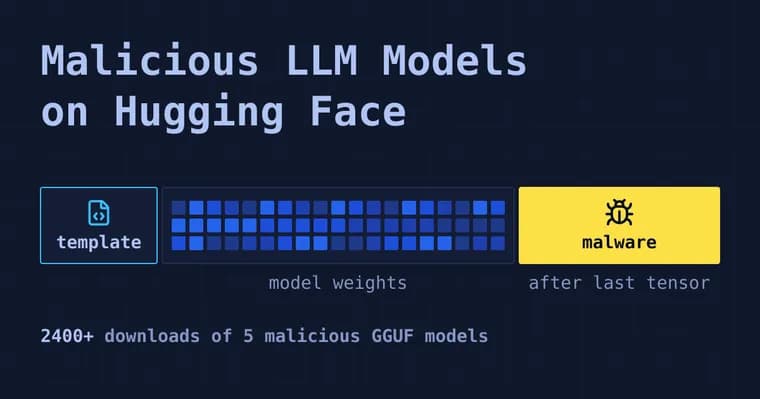
A malspark.com scan of 3.27 million Hugging Face repositories found five GGUF models with poisoned chat templates and 2,428 downloads. Two of them also carried a Windows trojan inside the model file. →
In a farewell message on GitHub, Heretic's author says their journey has ended, archives the repository and leaves it to the community to decide whether and how to continue. →
The PocketBase repository on GitHub was archived on October 26, 2026 and is now read-only. People who watched it for releases or security updates have to resubscribe at the new home. →
The Decoder·🔥65Glonce rating65Impact50Novelty65Relevance95Surprise45Players55Credibility75
A UK AI Security Institute study questions what simulated sabotage tests of AI agent monitors prove. In its case study, changing only the attack method lifted a GPT-5.4 monitor's miss rate from 0.2 to 0.5 percent to nearly 23 percent. →
The Decoder·🔥64Glonce rating64Impact50Novelty55Relevance100Surprise40Players70Credibility70
Google DeepMind wants to measure how reliable AI is, not just its peak performance. In early results reported by The Decoder, top models solve nearly every task family at least once, yet none stays error-free across repeated runs and variations. →
Audible's US website no longer lets buyers download purchased audiobooks straight to a computer as files, according to a consumerrights.wiki article. Browser streaming remains, alongside app routes such as the Windows tool AudibleSync, which has limits. →
The Decoder·🔥60Glonce rating60Impact55Novelty40Relevance85Surprise45Players75Credibility70
Liam Byrne, who chairs a House of Commons committee, wants the full METR report on the pace of AI R&D at Anthropic by December 4. METR says Anthropic cut major parts before publication. →
A small model of SFO at tinysfo.com shows planes, trains and ATC, with most elements running live and plenty of hidden easter eggs. Caltrain positions are only estimates. →
A new method called SPLICE builds local training targets from failed attempts in long-horizon agent reinforcement learning. Its authors report beating GRPO by 2.8 to 9.8 percentage points across four settings. →
Anthropic’s Edwin Arbus rejected user claims that Claude sabotages work, blaming some of the behavior on “overcaution” during long-running tasks. The company did limit AI research capabilities in Fable 5.2. →
A developer working on the Rust compiler's new trait solver says it will land in Rust 1.102.0, after performance proved a major late blocker. Their writeup starts from first principles. →
A new paper uses a frozen encoder's intermediate representations as step-by-step generation targets. The authors report 1.74 FID on ImageNet 256x256 at 1.55B after only 5 training epochs. →
The Decoder·🔥57Glonce rating57Impact50Novelty40Relevance92Surprise35Players45Credibility65
Robotics AI startup Embo has raised $110 million in seed funding in a round it says was led by Andreessen Horowitz, with Nvidia among the backers. The goal is AI models for smarter everyday robots. →
Peat keeps Neon's storage engine running on Postgres 18 and 19 and adds a Kubernetes operator to install and run it. The project calls itself alpha, though it already runs Zabaca's own production databases. →
To run dynamic Prela queries without writing a parser, the language's author implemented relational operators in Lua that build a syntax tree for a Rust backend. →
CEO David Ha says Sakana AI's planned foundation model, Sawara, serves a long-term industrial goal as well as near-term security needs. A smaller version is targeted for early 2027. →
In his tech predictions for 2027 and beyond, Werner Vogels argues that computing will draw more on the brain, and that in 2027 AI agents will attack software at every stage of development before real attackers do. →
The Decoder·🔥52Glonce rating52Impact45Novelty35Relevance70Surprise45Players65Credibility70
The mathematician expects AI to reorganize his field around much larger collaborations. He also argues that major tech companies' models produce proofs without understanding them. →
A paper presents DemoFoundry, an automated framework that pairs coding agents with generative rendering to synthesize robot demonstrations. The authors say policies trained on them approach the performance of training on an equal number of real ones. →
A paper introduces CARE-OPD, an on-policy distillation method for long-horizon agents. Its authors report 59.5% task success on SWE-bench Verified, with 45% less end-to-end training time than asynchronous online distillation. →
A paper introduces StateWeaver, an agentic approach that carries story state from shot to shot in long-video generation. Its authors report that it outperforms existing methods across multiple benchmarks. →
A newly appointed tech lead argues that real engineers treat unexpected system behaviour as something to investigate, and advises juniors not to simply pass the problem on, to Claude included. →
AffrescoUI is a native UI engine whose apps are written in a sandboxed Clojure dialect. According to its README, people and AI agents can change them live, under permission rules and review. →
A group calling itself the Cryptography Incident Review Group (CIRG) says it aims to review and help navigate cryptanalytic advances, including how to disclose a break. Its site lists 21 members. →
Archive95, posted under a Show HN title, describes itself as an independent web archive focused on material that predates or has otherwise evaded more mainstream archives. →
Ars Technica·🔥45Glonce rating45Impact35Novelty45Relevance70Surprise20Players25Credibility80
Kagi, known for its subscription search engine, has launched a Gmail-like email service and is rolling out a calendar with it. It costs $9 a month on its own or comes with the $25 Kagi Ultimate plan. →
A post on adamgreenough.net finds that more than half of WordPress sites use a PHP version that will lack official support by January, with PHP 8.2 ending on 31 December. Whether old versions still get security patches often depends on the host. →
A paper proposes BiSAT, a speech tokenizer that learns sound detail and linguistic content in separate spaces but outputs one code sequence. Its authors say the resulting text-to-speech system performs comparably to leading baselines with less training data. →
A new paper introduces LayoutRecall, a multi-round image editor that stores how objects look on the faces of 3D boxes and reuses it later, along with a benchmark called LayoutLoop. →
The first post in a Hugging Face series trains four agents sharing one Qwen3-0.6B model to communicate and sort privately held numbers. In the original 75-update run, training success rose from 6.6% to 82.3% while tokens per team attempt fell 37.4%. →
A paper comparing ways for smaller LLMs to pick the right knowledge-base entity reports that the benefit of reasoning is negligible in-domain and decisive in the true zero-shot setting. →
A research paper introduces Radev, a multimodal model that scores candidate answers about 3D CT scans in a single forward pass and is trained to tie its confidence to evidence from the relevant organ. →
Simon Willison·🔥42Glonce rating42Impact25Novelty30Relevance80Surprise25Players40Credibility60
After building an editable SVG poster with Gemini 4 Neon, Simon Willison argues that for much design work, images written as code are a better bet than output from dedicated image models. Photorealism is the stated exception. →
Simon Willison·🔥39Glonce rating39Impact30Novelty25Relevance65Surprise20Players20Credibility85
Simon Willison highlights a trait of sqlite3_rsync, a tool dating to 2024: it can send a database snapshot to another machine without first duplicating it on local disk. →
ABC reports that off-the-shelf quadcopters fitted with explosives have surged across conflicts, raising risks to civilians. UN talks in Geneva on so-called killer robots ended with an agreement to extend discussions to 2028. →
Wired reports that data-driven efforts, some coordinated by the US government and airlines, could bring fliers closer to smoother flights. Scientists say perfect prediction is impossible. →
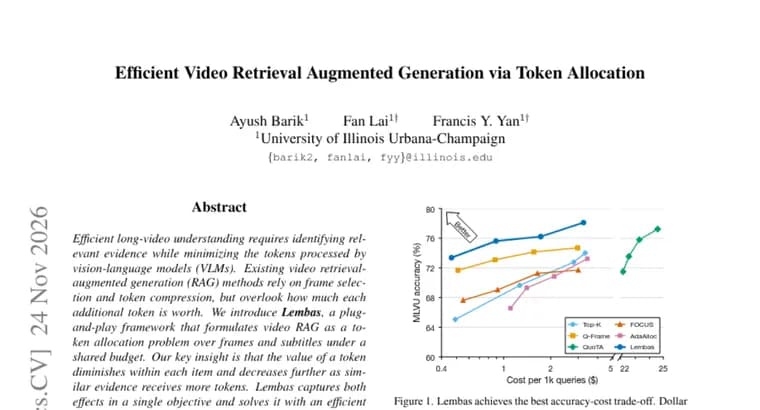
A new paper introduces Lembas, which splits a shared token budget across video frames and subtitles. Its authors report accuracy gains of up to 7.2 percentage points over state-of-the-art baselines at comparable compute. →
A new paper proposes DAWIN, a continuous-time neuron that factors in elapsed time. Its authors report wins over Neural CDE on 9 of 11 parameter-matched tasks and over a ReLU-MLP on 8. →